Project introduction
Novanova Studio is an AI Agent-powered visual creation workspace. Images, videos, the infinite canvas, prompts, and assets stay connected in one creative workflow.
Core capabilities
- Conversational creation: Describe an intent in natural language and let the Agent choose tools from context.
- Image and video generation: Use multiple provider channels, reference media, and asynchronous task progress.
- Infinite canvas: Organize ideas, media, generated results, and task relationships in one editable space.
- Reusable assets: Save results, prompts, and uploads for later rounds.
Typical workflow
- Configure model channels and object storage.
- Enter a creative goal in Image, Video, or Canvas.
- Let the Agent ask for missing parameters and submit an asynchronous task.
- Review, iterate, and save the result to Assets or Canvas.
- Continue the next round with the same context.
System architecture
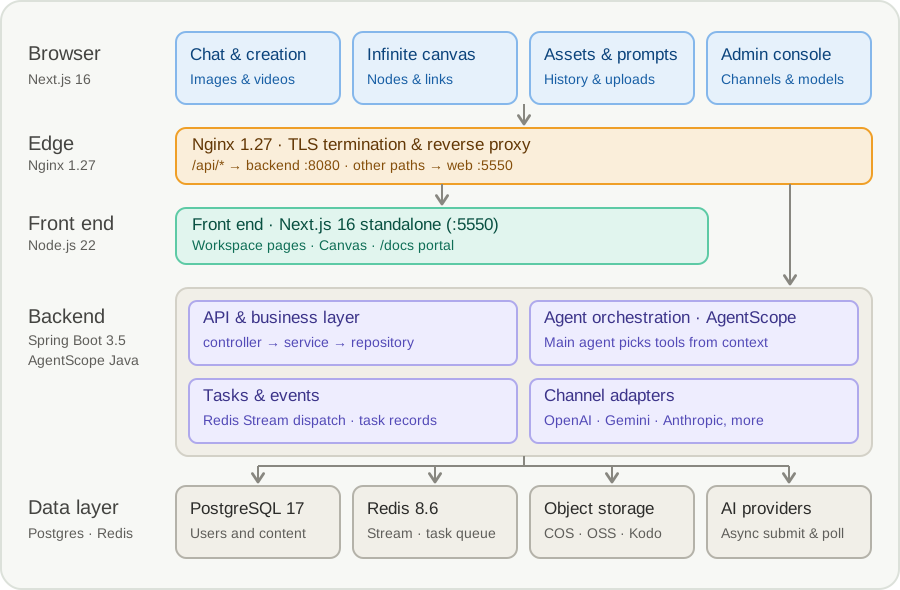
The system is arranged in five layers: the browser workspace, the edge layer, the front-end service, the back-end service, and data plus external dependencies. The browser only calls same-origin /api/v1/**; AI channel keys and object storage credentials stay on the server and are never shipped to the browser.
| Layer | Stack | Responsibility |
|---|---|---|
| Browser workspace | Next.js 16 App Router, React 19, Ant Design 6, Tailwind, Zustand, React Flow | The UI for image, video, the infinite canvas, assets, the prompt library, and the admin console |
| Edge | Nginx 1.27 | TLS termination and reverse proxy: /api/* goes to the back end with buffering off so SSE can stream, everything else goes to the front end on :5550 |
| Front-end service | Next.js standalone (Node.js 22) | Page rendering, the /docs portal, and static assets |
| Back-end service | Java 21, Spring Boot 3.5, Spring WebFlux, AgentScope Java, Fastjson2, R2DBC | Reactive APIs, Agent orchestration and tool calls, AI task scheduling and polling, auth, and business services |
| Data and external dependencies | PostgreSQL 17 + Flyway, Redis 8.6 + Stream, object storage (COS / OSS / Kodo), model providers | Persisting users and creations, async task dispatch and recovery, media storage, and model inference calls |
The path of a generation request
- The browser submits a creative goal from the workspace or the canvas.
- Nginx forwards
/api/v1/**to the back end and keeps the SSE response unbuffered. - The Agent picks tools from context (image, video, canvas, storyboard) and fills in missing parameters.
- The task is written to PostgreSQL and dispatched through Redis Stream; most providers expose async task APIs, which the server polls at a shared interval.
- Results are written back to the database and object storage, and the browser gets them over SSE or polling, so they can land directly on the canvas or in Assets.
A Docker deployment starts PostgreSQL, Redis, Nginx, the front end, and the back end together; see Start with Docker. API and database design notes live in the docs-api/ directory.